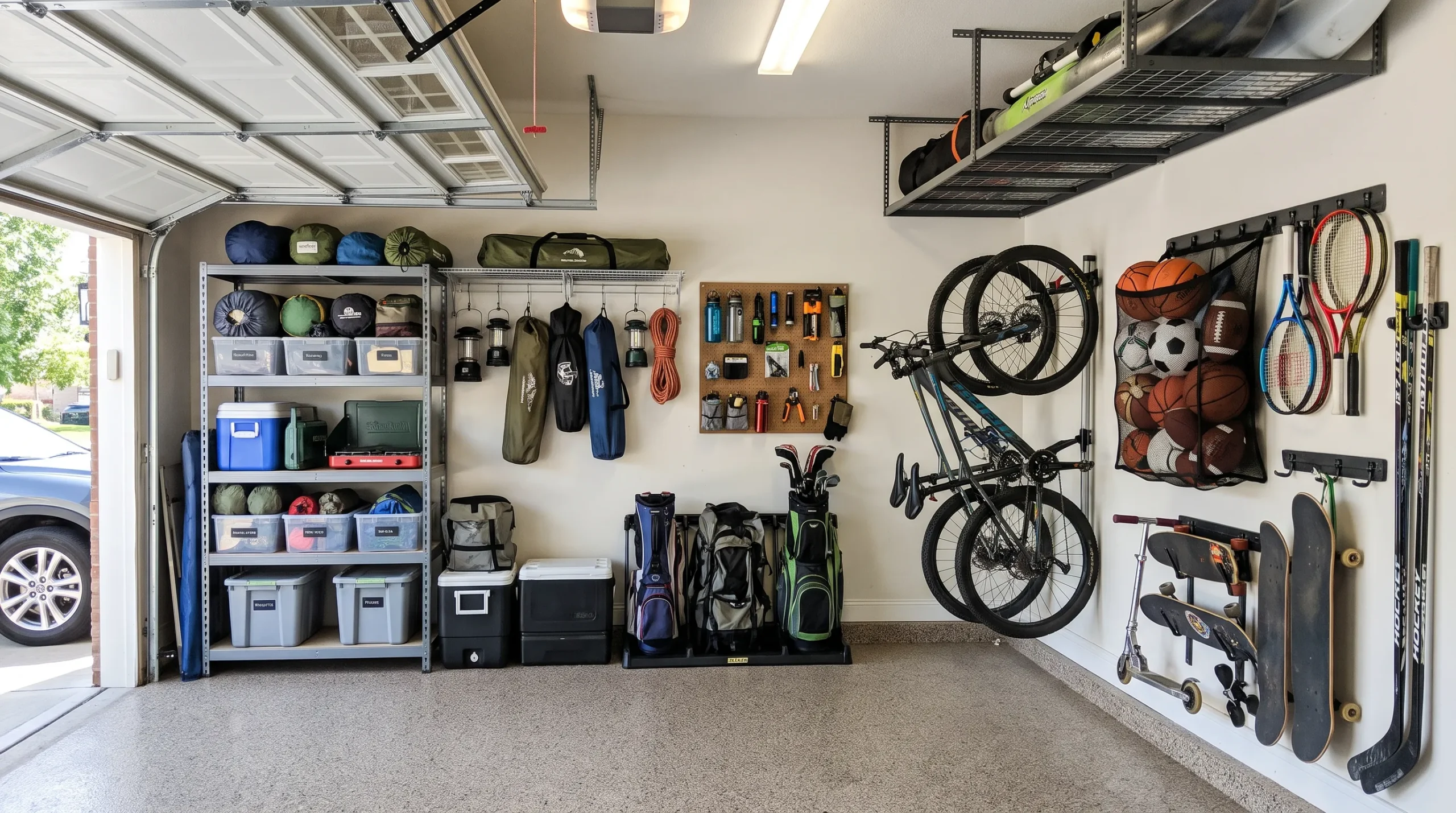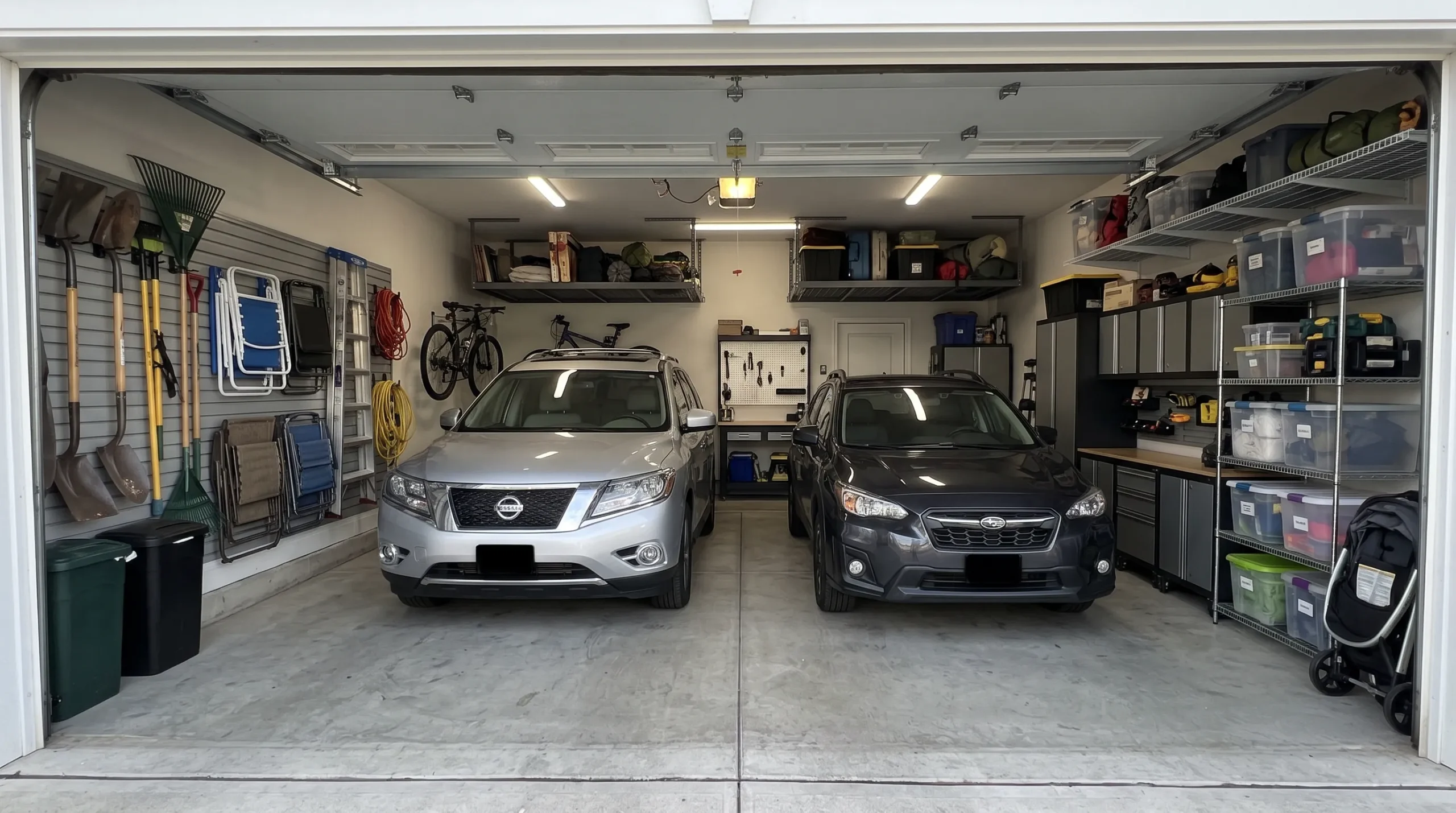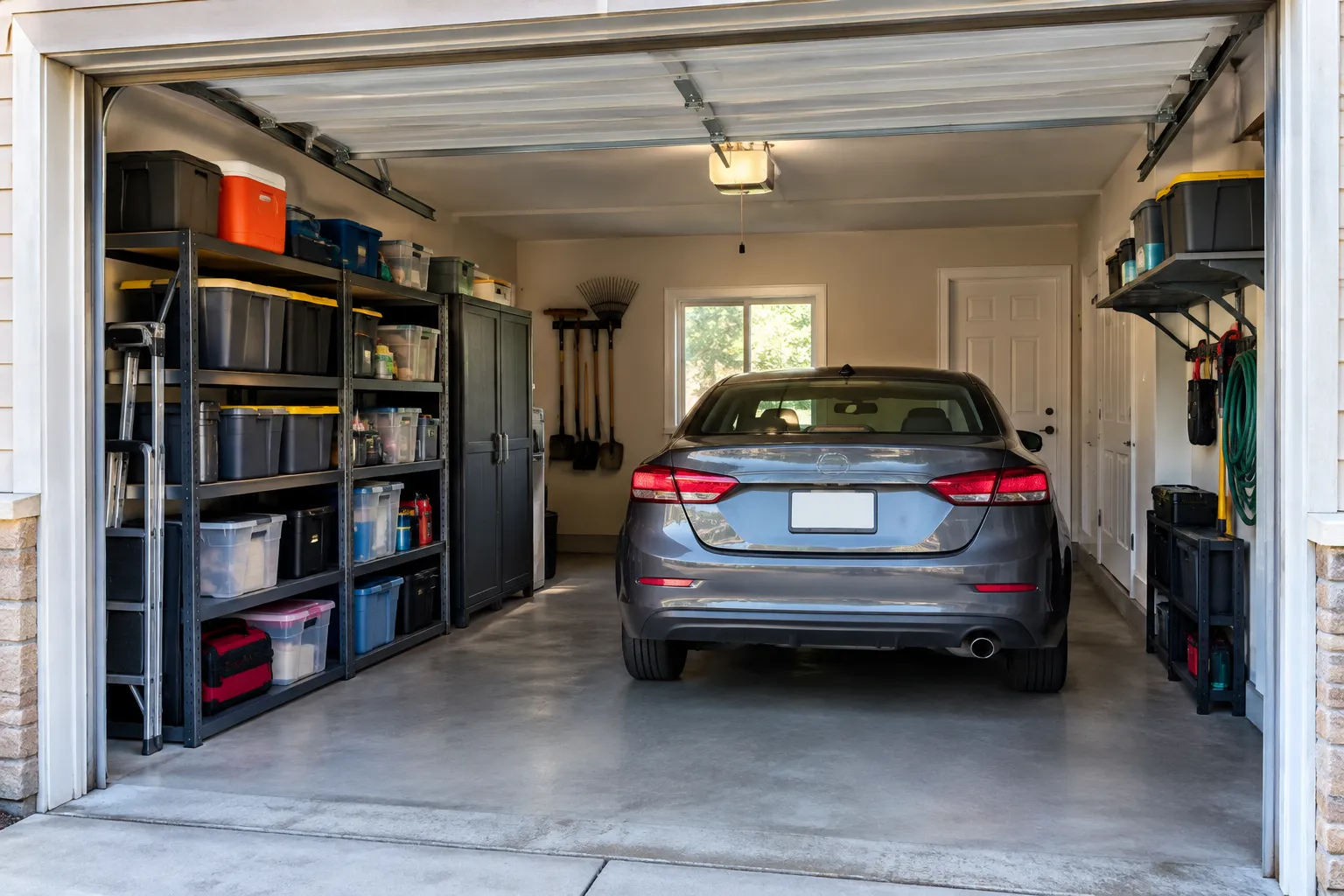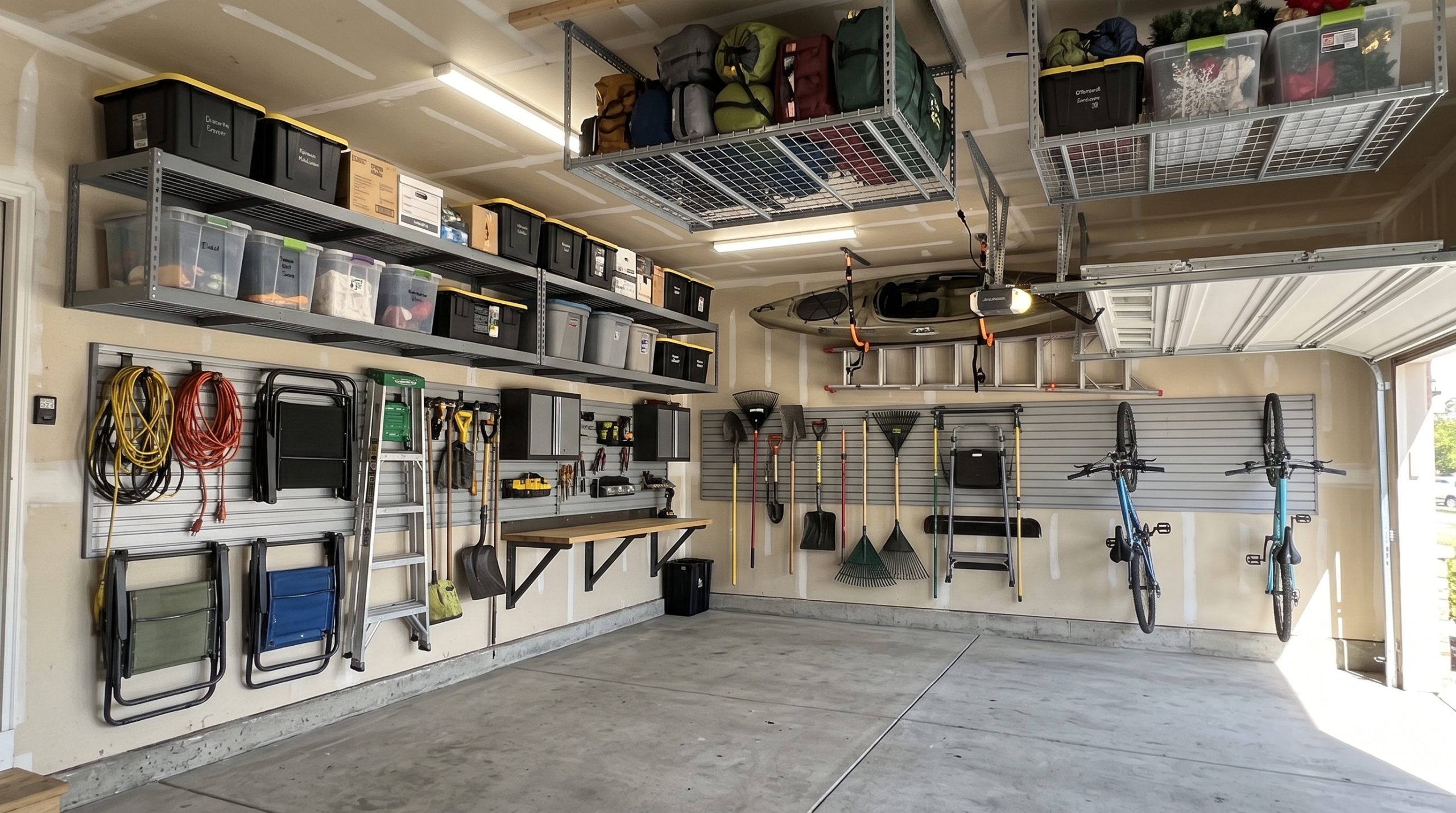




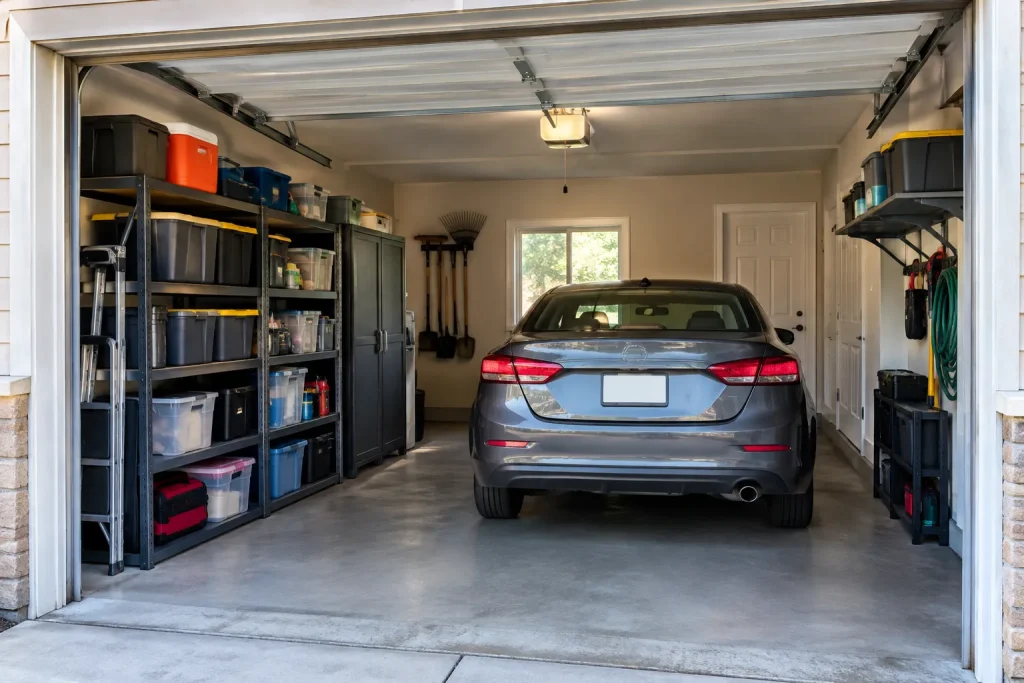
Yes, but only if the storage comes off the floor. A one-car garage is roughly 12 by 22 feet, and a mid-size sedan plus its open doors claims most of that. What you have left is not floor space, it is wall space and ceiling space, and there is more of it than most homeowners realize. Shallow wall systems, hanging hardware for long items, and a single overhead rack placed over the hood will hold the contents of a typical two-car garage’s worth of clutter. The rule that governs everything here is depth: in a narrow bay, a shelf that sticks out too far, costs you more than it stores.
Key takeaway
- Depth matters more than length. Shelving deeper than about 16 inches starts eating the space you need to open a car door.
- Measure the open door swing before you plan a single wall. That measurement, not the wall length, sets your usable depth.
- Wall-mounted beats free-standing every time in a narrow bay, because free-standing units convert floor space into storage instead of recovering it.
- One overhead rack over the hood is usually all a single bay can take. Two is how you end up unable to park.
- Long awkward items (bikes, ladders, rakes) are the biggest space thief in a small garage, and they are also the easiest to fix with hooks.
- Certain items must not be stored in an unheated single-car garage; removing them creates extra space that shelves cannot match.
1. Measure the door swing before you plan anything

How to measure a one-car garage before adding storage
Start with your car doors open, not with a tape on the wall. Park the vehicle you actually use, open the driver’s door to its normal position, and measure from the wall to the door edge. That gap is your real usable depth on that side, and it is almost always smaller than people guess.
Do the same on the passenger side, then measure from the front bumper to the front wall and from the rear bumper to the door opening. You now have four numbers, and every storage decision follows from them.
The reason this comes first: a 24-inch deep shelving unit in a one-car garage is not a storage solution, it is a reason to park outside. Most single bays can carry 12 to 16 inches of depth on the long walls and more on the front wall, where nothing has to open.
If you want the wider framework behind this, How Can You Make More Storage Space in Your Garage Without Losing Floor Space? covers the same logic applied to larger garages.
Call a pro if: you cannot find a depth that works on either long wall. That usually means the bay is narrower than standard, and the fix is a mixed-depth plan rather than one uniform run.
2. Go vertical on the longest uninterrupted wall
How to use vertical storage in a narrow garage
Pick the wall with the fewest interruptions and treat it as your primary storage wall. In most single bays that is the wall opposite the entry door, because the entry side is broken up by the door swing, a light switch, and usually the electrical panel.
Running one continuous system down a single wall stores far more than three separate units scattered across three walls, and it keeps the other walls clear for circulation. Continuity is what small garages lack most.
Slatwall is often the better call than shelving, because it is shallow by design and the hardware moves. See what makes garage slatwall better than shelves or pegboards for the comparison, and garage slatwall ideas for layouts.
Call a pro if: your primary wall is block, brick, or unfinished. Anchoring a full-length run into masonry needs the right fastener and a hammer drill, and a failure on a loaded run in a tight bay lands on the car.
3. Use shallow shelving, not deep shelving
How deep should garage shelving be in a one-car garage
Twelve to sixteen inches is the working range. Deeper shelves hold more per linear foot on paper, but in a narrow bay they push into the door swing, and anything at the back becomes unreachable without moving the car.
Shallow shelving also changes what you store. A 12-inch shelf holds one row of standard totes rather than two stacked front to back, which sounds like a loss but is actually the point: you can see and reach everything, so nothing gets buried and forgotten.
Two practical notes. Standardize your bins to one size before the shelving is planned, so the shelf depth is fully used. And go higher rather than deeper, since vertical runs cost nothing in floor space. Our guides to the best wall-mounted shelves for a garage and adjustable garage shelving cover the options, and common garage shelving mistakes covers what to avoid.
Call a pro if: you are running shelving above shoulder height along a wall a car parks next to. Load path and anchoring matter more here than in a wide garage, because there is nowhere for a failure to fall except onto the vehicle.
4. Hang the long, awkward items instead of shelving them
How to store bikes, ladders, and long tools in a small garage
Hooks, not shelves. Bikes, ladders, extension poles, rakes, folding chairs, and sports gear are the items that defeat small garages, because they are long in one dimension and nearly weightless in the others. A shelf sized to hold a ladder wastes enormous volume around it.
Wall hooks and ceiling hooks turn those items into a flat layer against a surface you were not using. A bike hung vertically on a hook occupies roughly a square foot of wall. The same bike on the floor occupies eight or more, plus the clearance to walk past it.
For specifics by item type, see space-saving garage bike storage and garden tool garage storage options. Sports and camping equipment is its own category with its own rules, covered in Where Do You Put Sports and Camping Gear in a Garage? 9 Ways to Get It Off the Floor.
Call a pro if: you are hanging anything heavy from the ceiling rather than the wall. Ceiling hooks have to engage framing, and a hook that pulls out over a parked car is an expensive lesson.
5. Add one overhead rack, placed over the hood
How to add overhead storage in a one-car garage without losing headroom
One rack, over the front of the vehicle, is the right amount for a single bay. Two racks is how people end up parking in the driveway.
Placement is the whole game. Put it over the hood or against the front wall, never over the middle of the bay where you walk and where the tailgate or hatch opens. Then check two heights: the lowest point of your garage door when it is fully open, and the roof of your tallest vehicle. Your rack has to live between those numbers.
A single overhead rack is enough for holiday decorations, luggage, and off-season gear, which is most of what a small garage needs to store long term. Overhead storage covers the systems, and garage ceiling storage covers placement in more detail. If you are trying to solve clearance for more than one vehicle, Can You Add Garage Storage and Still Park Two Cars? 7 Things to Measure First walks through every measurement.
One safety note that matters more in a tight bay: keep racks, bins, and hanging items entirely clear of the garage door’s path and its safety sensors. The U.S. Consumer Product Safety Commission sets the federal entrapment protection standard that residential garage door openers have to meet, and those protections only work when nothing is obstructing the door or its photo eyes.
Call a pro if: your ceiling is framed with engineered trusses rather than solid rafters. Trusses are engineered for a specific load, and hanging several hundred pounds from the bottom chord without verifying capacity is a structural risk you cannot assess by eye.
6. Replace free-standing units with wall-mounted ones
Why free-standing shelving does not work in a one-car garage
Because it converts floor space into storage instead of recovering it. A free-standing rack sitting against the wall still occupies its full footprint on the concrete, plus the clearance you need to reach it. In a wide garage that is affordable. In a single bay it is the difference between parking inside and not.
Wall-mounted systems put the same storage volume above the floor plane entirely, leaving the concrete clear. The swap is usually the single biggest gain available in a small garage, and it does not require buying more storage, only different storage.
There is a secondary benefit that matters in Omaha specifically. Nothing sitting on the slab is in contact with meltwater, road salt, or the damp that comes off a car in February. Cardboard boxes on the floor of a Nebraska garage do not survive many winters.
Call a pro if: you are replacing an existing system rather than starting from bare walls. Removal, wall repair, and sequencing usually take longer than the new install itself.
7. Put a short cabinet run on the front wall, not the side
Where to put garage cabinets in a one-car garage
On the front wall, where nothing has to open past them. The front wall is the only surface in a single bay that can carry depth without cost, because no car door swings there and nobody walks past it.
Keep the run short. A single bay usually supports a two or three cabinet run, enough to contain the loose small items that make a garage look chaotic: chemicals, fasteners, automotive fluids, cleaning supplies. Base cabinets sit on the floor, so every foot of cabinet is a foot of floor you are choosing to spend. Spend it where the floor was not usable anyway.
Wall-mounted cabinets are the better choice if you need the floor under them. See garage cabinets for the range, and garage cabinets with slatwall for the combination that works best in tight spaces, since the slatwall carries the volume and the cabinets carry the clutter.
Call a pro if: your slab pitches toward the door, which most Omaha garage floors do. Cabinet runs have to be shimmed and leveled to the pitch or the doors will hang crooked and drift open.
8. Remove what should not be in the garage at all
What not to store in a one-car garage
The cheapest storage upgrade is owning less of what does not belong there. In a single bay this matters more than in a large garage, because there is no slack to absorb it.
Things that do poorly in an unheated Omaha garage:
- Paint and caulk, which are ruined by repeated freezing
- Canned food and pet food, which spoil and attract pests
- Photographs, paper records, and books, which take on humidity
- Electronics and batteries, which degrade at temperature extremes
- Anything upholstered, which holds moisture and grows mildew
This is a bigger factor here than in milder climates. National Weather Service climate records for the Omaha area show the annual swing between summer highs and winter lows, and an attached garage tracks the outside temperature far more closely than the house does.
Two related upgrades worth considering while the garage is empty. A coated floor is easier to sweep and does not shed dust onto everything stored above it, which is covered in garage flooring and in why weather destroys bare concrete in Omaha. And a coordinated design matters more in a small bay than a large one, because every surface is visible at once and mismatched systems read as clutter even when everything is put away.
Call a pro if: you are combining a floor coating with new storage. Coat the floor first. Doing it after cabinets and shelving are mounted is harder, slower, and more expensive.
What fits in a one-car garage
|
Storage type |
Typical depth |
Works in a single bay? |
Install |
|
Slatwall with hooks |
1 to 2 in |
Yes, best option for long walls |
Professional install |
|
Shallow wall shelving |
12 to 16 in |
Yes, on the primary wall |
Professional install |
|
Deep wall shelving |
20 in and up |
Front wall only |
Professional install |
|
Wall hooks for bikes and tools |
4 to 12 in |
Yes, highest value per dollar |
Professional install |
|
Single overhead rack |
24 to 48 in |
Yes, over the hood only |
Professional install |
|
Two or more overhead racks |
varies |
No, you will lose the parking spot |
Not recommended |
|
Wall-hung cabinets |
12 to 16 in |
Yes, front wall |
Professional install |
|
Base cabinets |
24 in |
Front wall only, short run |
Professional install |
|
Free-standing shelf units |
18 to 24 in |
No, costs more floor than it saves |
Not recommended |
The bottom line

A one-car garage is not short on storage capacity, it is short on floor. Measure your door swing first, run one continuous shallow system down your best wall, hang everything long and awkward, add a single overhead rack over the hood, and clear out what the Nebraska climate is going to ruin anyway. Done in that order, a single bay holds a surprising amount and still fits the car. For broader habits that keep it that way, see garage organization ideas in Omaha.
Small garages are the hardest ones to plan, because there is no room for a mistake in depth or placement. Platinum Garage Solutions measures and designs single-bay garages across the Omaha metro before anything gets mounted.
Schedule your garage storage consultation and get a plan built around your actual measurements.