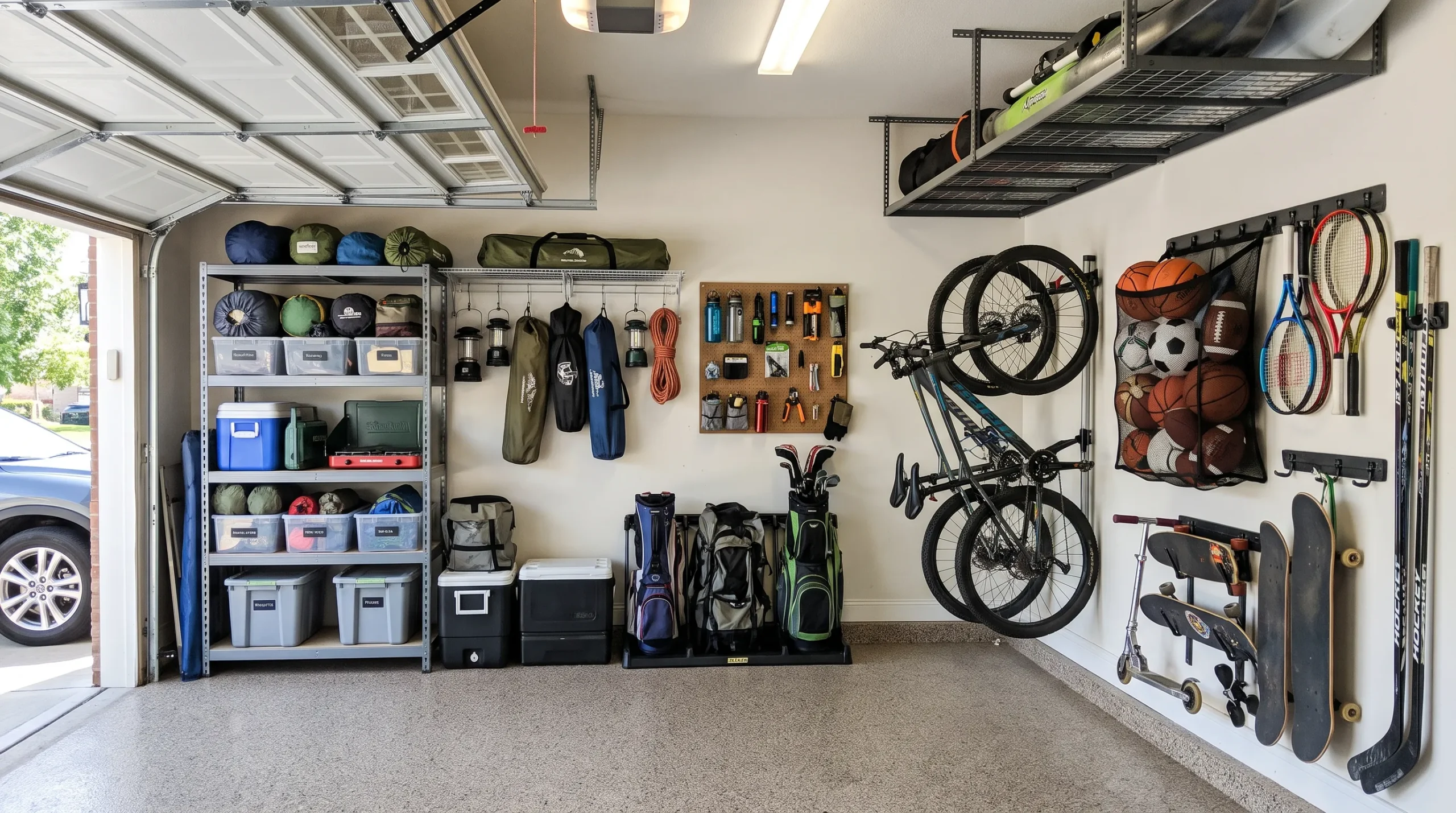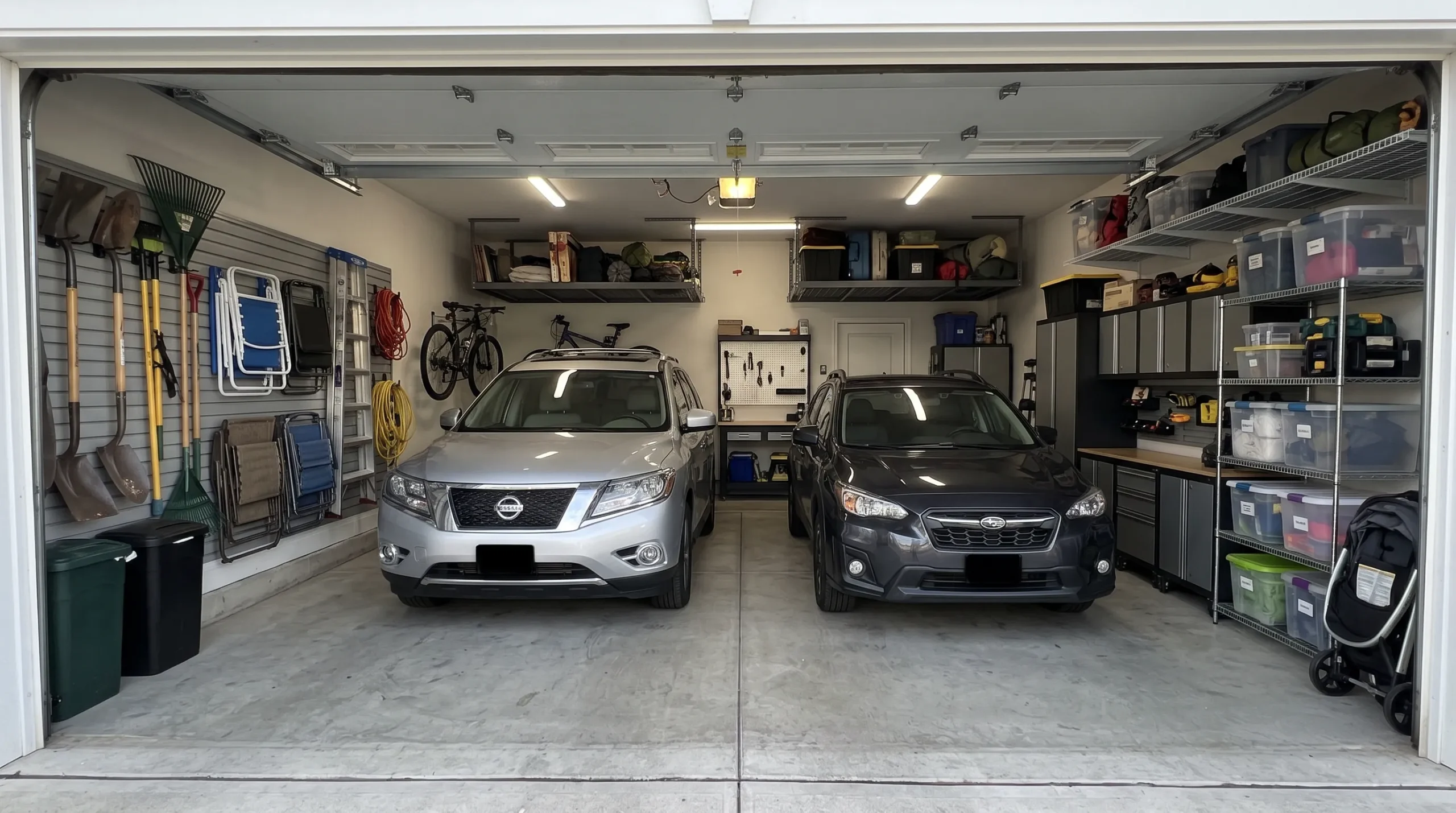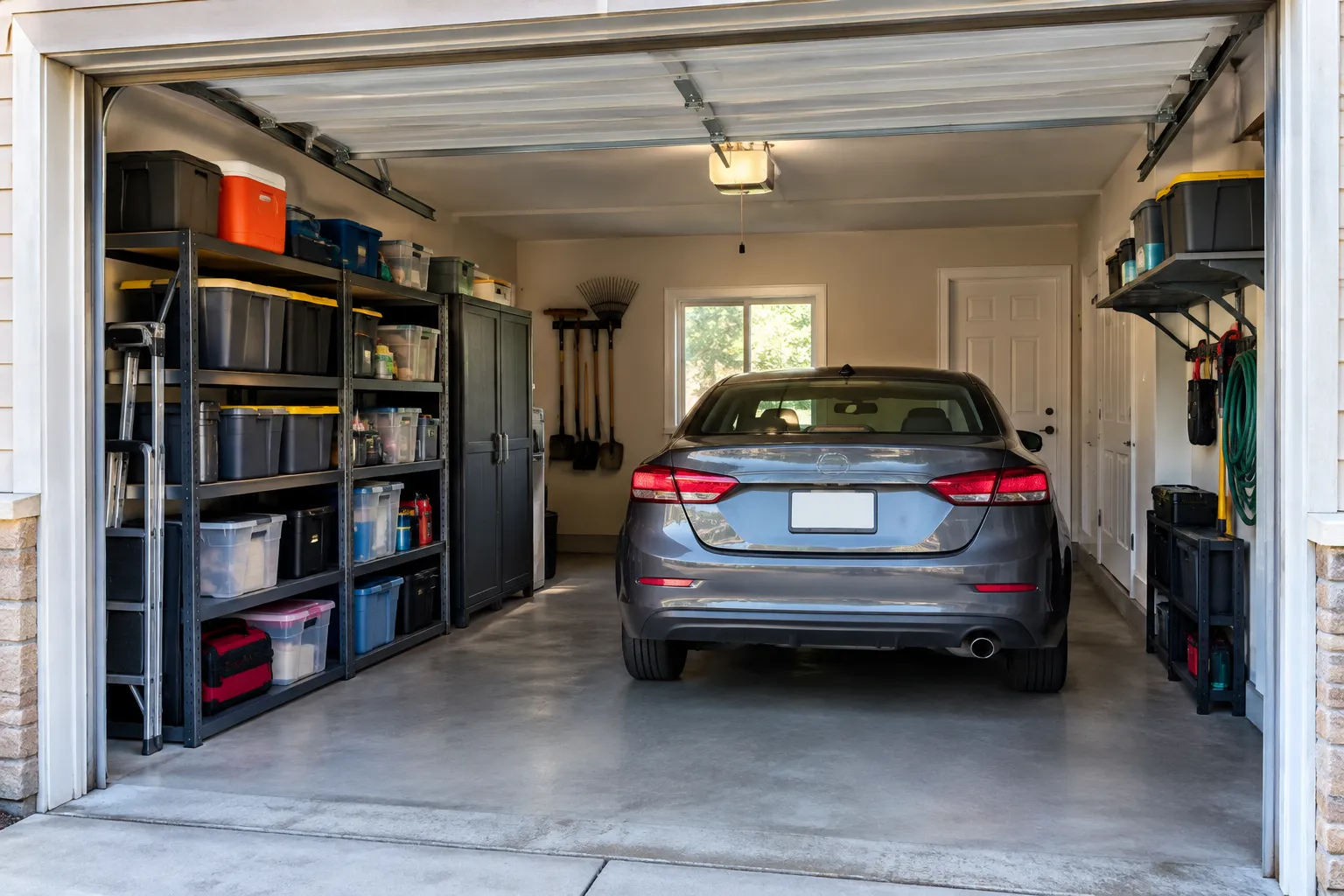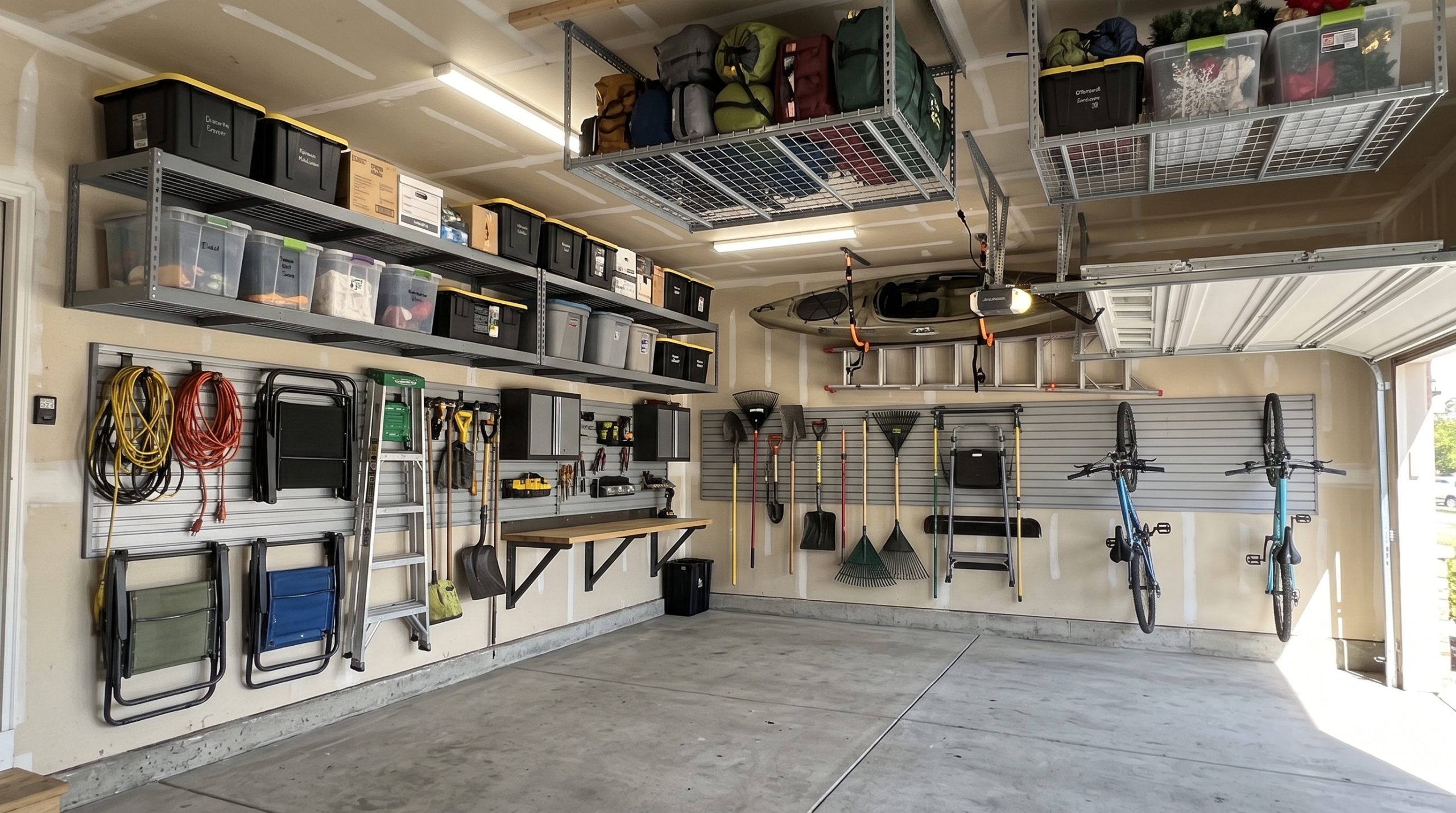




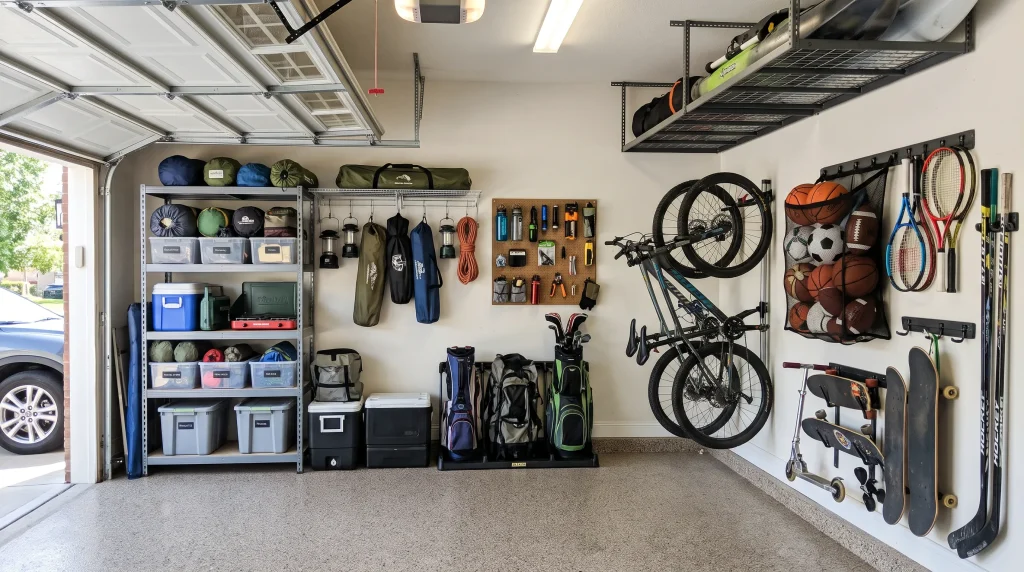
Sports and camping gear belong on the walls and ceiling, sorted by season rather than by sport. This category defeats ordinary shelving because the shapes are wrong: bats, poles, rackets, and rakes are long and thin, balls roll, and tents and sleeping bags are bulky but nearly weightless. Flat shelves waste enormous volume around all of it. Hooks, bars, and shallow bins handle it far better. The nine methods below cover every category, from bikes on vertical wall hooks to tents stored loose on a shelf instead of compressed in a stuff sack, and each one takes floor space back.
Key takeaways
- Sort by season first. Rotating gear on and off the wall matters more than which hooks you buy.
- Long items go on hooks, never on shelves. A shelf sized for a hockey stick wastes the volume around it.
- Balls need containment, not a shelf. They are the only category where a bin genuinely beats a hook.
- Wet gear should never dry on bare concrete, and it should never go into a sealed bin.
- Tents and sleeping bags store loose, not compressed. Long-term compression is what ruins them.
- An unheated Omaha garage is fine for most gear and wrong for a few specific items.
1. Sort by season before you buy any hardware

How to organize sports and camping gear in a garage by season
Split everything into what you use now and what you do not, then give each group a different zone. Current-season gear goes at hand height where you can grab it without moving anything. Off-season gear goes high on the wall or overhead.
This sounds like advice about tidiness. It is actually about capacity. Most households own three or four seasons of gear and can only reach one season at a time, so the wall only has to hold one season at a working height. That single decision roughly quadruples what a given wall can serve.
Set a rotation you will actually do. Twice a year is realistic for most families: one swap in spring and one in fall. Anything you did not touch across two full rotations is a candidate to sell or donate.
The broader version of this logic, applied to every category in the garage, is in How Can You Make More Storage Space in Your Garage Without Losing Floor Space?.
Call a pro if: you have gear for four or more people and no clear zones. At that volume the problem is layout rather than hardware, and buying more hooks will not fix it.
2. Hang bikes vertically on wall hooks
How to store bikes in a garage without losing floor space
Vertical wall hooks, one bike per hook, spaced so the handlebars clear each other. A bike hung by its front wheel occupies about a square foot of wall. The same bike parked on the floor occupies eight or more once you include the room to walk around it.
Two placement notes. Hang bikes on the wall you do not park a car door against, because pedals and handlebars stick out further than the wheel does. And stagger the heights slightly so adjacent handlebars nest rather than collide.
Heavier e-bikes are a different problem. They exceed what many standard hooks are rated for, and lifting one to shoulder height repeatedly is not realistic for most people. Those usually stay at floor level in a dedicated spot, or go on a wall-mounted rack rated specifically for the weight.
More detail on the options is in garage bicycle storage ideas.
Call a pro if: you are hanging more than two or three bikes, or any e-bike. Combined load on a short run of wall adds up quickly, and the fasteners have to engage framing rather than drywall.
3. Put long, thin items on a slatwall with adjustable hooks
How to store bats, sticks, rackets, and poles in a garage
Hooks on a slatwall, not a shelf. Baseball bats, hockey sticks, lacrosse sticks, tennis rackets, ski poles, and fishing rods all share the same profile: long in one dimension, small in the other two. A shelf built to hold them wastes most of its own volume.
Slatwall is the right surface here because the hooks move. Gear changes as kids grow and sports come and go, and a fixed hook arrangement is obsolete within a season or two. Being able to slide a hook six inches instead of patching drywall is the whole advantage.
Keep the run at a height where the tallest item still clears the floor. A hockey stick hung too low turns into an obstacle rather than storage.
See garage slatwall for the systems and how slatwall improves garage storage capacity and flexibility for why the adjustability matters over time.
Call a pro if: your walls are masonry or unfinished. Slatwall runs the full length of a wall, and a partial or improperly anchored run will sag under a loaded hook.
4. Contain the balls, do not shelve them
How to store balls and round equipment in a garage
Balls need a container with a lid or a lip, because they are the one category that defeats every open surface. A basketball on a shelf is a basketball on the floor within a week.
A vertical corral works better than a bin for volume: a tall, narrow enclosure with an opening near the top that you drop balls into and reach into from the side. It uses a footprint about the size of a laundry basket and holds far more than a flat bin.
Whatever you use, put it near the door you actually leave through. Ball storage that requires walking past the car does not get used, and unused storage is the same as no storage.
In a tight garage, containment options shrink fast, and the constraints in Can You Fit Storage in a One-Car Garage? 8 Ideas That Actually Work apply directly.
Call a pro if: nothing you have tried stays organized for more than a month. That usually means the storage is in the wrong location rather than the wrong shape.
5. Give wet gear a ventilated spot and a floor that can take it
Where to store cleats, boots, helmets, and pads in a garage
On an open, ventilated rack, never in a sealed bin. Cleats, boots, pads, and gloves come home damp, and a closed container turns damp gear into mildewed gear within a few days. Airflow is the entire requirement.
Helmets deserve specific attention. Store them somewhere they will not be dropped or crushed, and inspect them rather than assuming they are fine. The U.S. Consumer Product Safety Commission sets the mandatory federal safety standard for bicycle helmets, and a helmet that has taken a real impact should be replaced rather than stored for the next kid.
The floor underneath matters more than people expect. Wet cleats, muddy boots, and snowy gear drip, and bare concrete absorbs it and holds it. A coated floor sheds the water and sweeps clean instead, which is one of the practical arguments for garage flooring in a house with active kids.
Footwear specifically has its own solutions in garage shoe storage ideas.
Call a pro if: you are seeing mildew or persistent damp in one area of the garage. That is usually a drainage or ventilation issue, and no storage system will solve it.
6. Store tents and sleeping bags loose, not compressed
How to store a tent and sleeping bag in a garage
Loose, dry, and out of the stuff sack. This is the single most common way people ruin camping gear, and it is entirely avoidable.
Sleeping bag insulation works by loft, and long-term compression in a stuff sack permanently flattens it. Store bags loose on a shelf, in a large mesh sack, or hung. Tents have a related problem: a tent packed away even slightly damp will develop mildew that degrades the waterproof coating, and it cannot be reversed.
So the sequence after every trip is dry it fully, then store it loose. A shelf is the right home for both, because they are bulky and light, which is exactly what shelving is good at. See how to maximize garage shelving space for getting the most out of the run.
An unheated garage is generally an acceptable place for this gear, as long as it is dry. What it is not good for is anything that degrades at temperature extremes, and Nebraska has real extremes in both directions. National Weather Service climate records for the Omaha area show the annual range, and an attached garage tracks the outdoor temperature far more closely than the house does.
Call a pro if: your garage has a humidity problem rather than a storage problem. Gear stored correctly in a damp garage still fails.
7. Stack coolers and camp kitchen gear in shallow bins
How to store coolers and camping kitchen equipment in a garage
Shallow shelving with uniform bins, grouped by function rather than by trip. One bin for the camp kitchen, one for lighting and batteries, one for sleeping accessories. Grouping by function means you can pull two bins and be packed instead of hunting through six.
Coolers are the exception that needs its own rule: store them with the lids cracked open. A sealed cooler grows mold and holds odor, and propping the lid solves it completely.
Standardize the bins before you buy shelving, not after. Mixed sizes waste shelf depth, and in a garage that depth is the constrained dimension. Clear bins beat opaque ones for this category specifically, because camp gear is hard to identify by shape through a solid wall.
Call a pro if: you are loading a long shelving run heavily. Bins full of camp gear are heavier than they look, and the anchoring has to reflect the loaded weight rather than the empty shelf.
8. Put once-a-year gear overhead
What sports and camping gear belongs in overhead garage storage
The things you touch once or twice a year and nothing else. Rooftop cargo boxes, extra tents, spare sleeping pads, and the camping chairs that only come out in summer are ideal overhead candidates. Weekly gear is not, because retrieving anything from overhead is a two-step job with a ladder.
Placement follows the same rule as everything else on a garage ceiling: over the hood of a parked vehicle or against the front wall, never over the middle of the bay where you walk and where a hatch opens. Overhead storage covers the systems, and signs you need overhead storage solutions covers when it becomes worth adding.
If you are fitting overhead racks around two parked vehicles, the clearance measurements in Can You Add Garage Storage and Still Park Two Cars? 7 Things to Measure First come first.
Call a pro if: your ceiling is framed with engineered trusses rather than solid rafters. Trusses carry a specific designed load, and hanging weight from the bottom chord without verifying capacity is a structural risk you cannot judge visually.
9. Lock up what should not be within reach
What sports and camping gear should be stored in a locked cabinet
Anything fuel-based, pressurized, sharp, or chemical. Camp stove fuel canisters, lantern fuel, bear spray, hatchets, fillet knives, and lighter fluid all belong behind a door rather than on an open hook, particularly in a garage where children come and go.
Two rules that matter more than the lock. Fuel canisters and pressurized cylinders should not sit in a closed cabinet near a gas water heater or furnace, so choose the cabinet location with the appliance in mind. And nothing fuel-related should share a cabinet with anything that generates heat or sparks.
Garage cabinets are the right tool for this, and the benefits of garage cabinets covers what else they solve in a garage that is otherwise all open storage.
Call a pro if: you are storing more than a small quantity of fuel of any kind. Volume is what turns a normal storage question into a fire safety question.
Where each type of gear actually goes
|
Gear |
Best method |
Where it goes |
Watch for |
|
Bikes |
Vertical wall hooks |
Side wall, no car door |
E-bike weight ratings |
|
Bats, sticks, rackets, poles |
Slatwall hooks |
Primary wall, at height |
Hanging too low |
|
Balls |
Vertical corral or lidded bin |
Near the entry door |
Open shelves never work |
|
Cleats, boots, gloves |
Open ventilated rack |
Near the entry, off the floor |
Sealed bins cause mildew |
|
Helmets |
Shelf or hook, uncrushed |
Hand height |
Replace after any impact |
|
Tents |
Loose on a shelf, fully dry |
Mid-wall shelving |
Never store damp |
|
Sleeping bags |
Loose or hung, uncompressed |
Mid-wall shelving |
Stuff sacks flatten loft |
|
Coolers |
Shelf, lid propped open |
Shallow shelving |
Sealed lids grow mold |
|
Camp kitchen |
Clear bins by function |
Shallow shelving |
Standardize bin sizes |
|
Cargo boxes, spare tents |
Overhead rack |
Over the hood or front wall |
Truss capacity |
|
Fuel, blades, bear spray |
Locked cabinet |
Away from gas appliances |
Never near a pilot light |
The bottom line

Sports and camping gear takes more floor space than any other category in a typical garage, and it responds to the fewest shelves. Sort by season, hang everything long on hooks, contain the balls, ventilate anything that gets wet, store tents and bags loose, and reserve the ceiling for what you touch once a year. That handles nearly all of it without a single square foot of floor.
Households with gear for several people usually need the whole wall planned at once rather than solved hook by hook, which is where a coordinated design pays off, since gear storage tends to sprawl across every surface it can reach.
Platinum Garage Solutions designs gear storage around what your family actually plays, across the Omaha metro.
Schedule your garage storage consultation and get a wall plan built around your gear rather than a catalog.