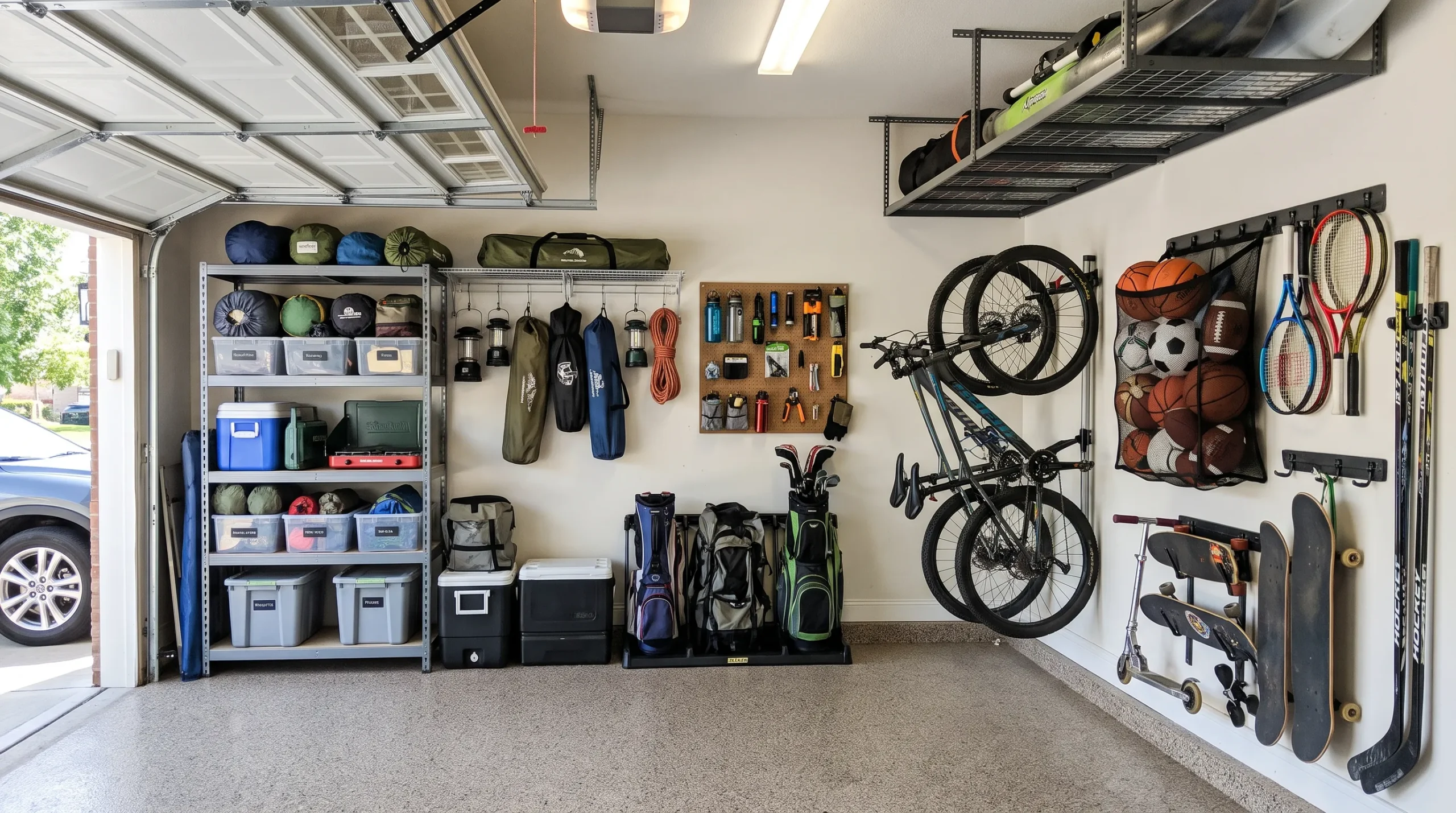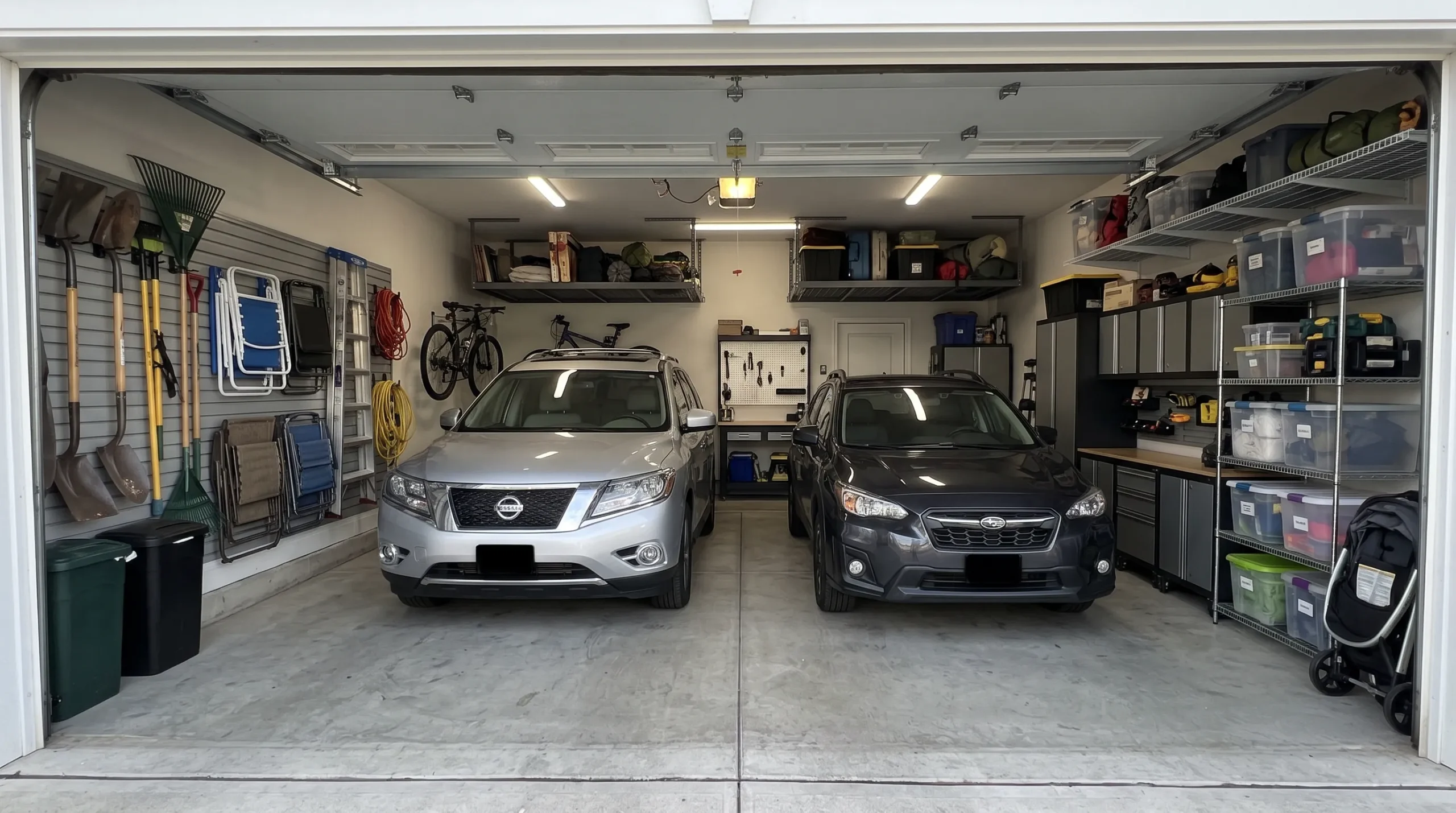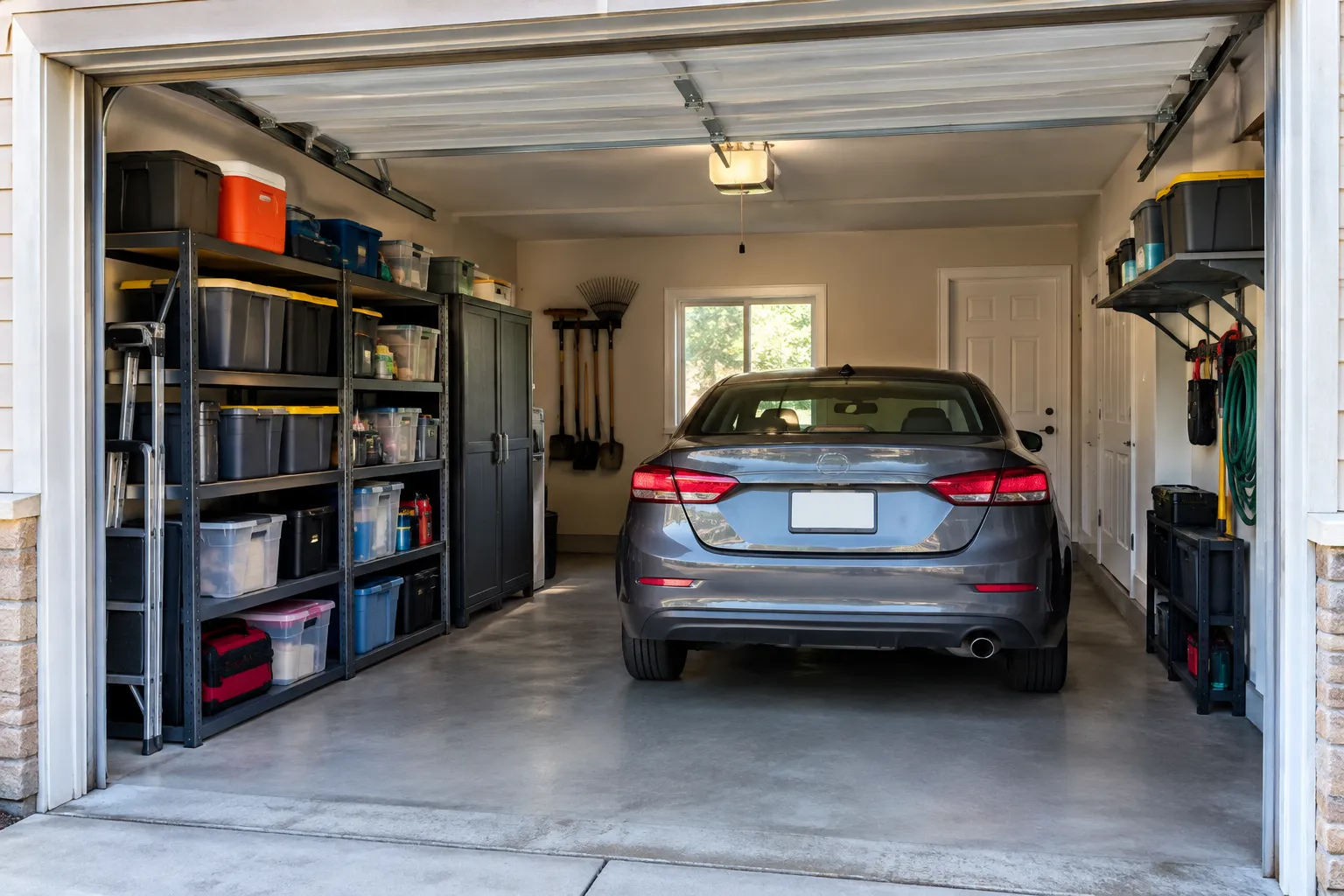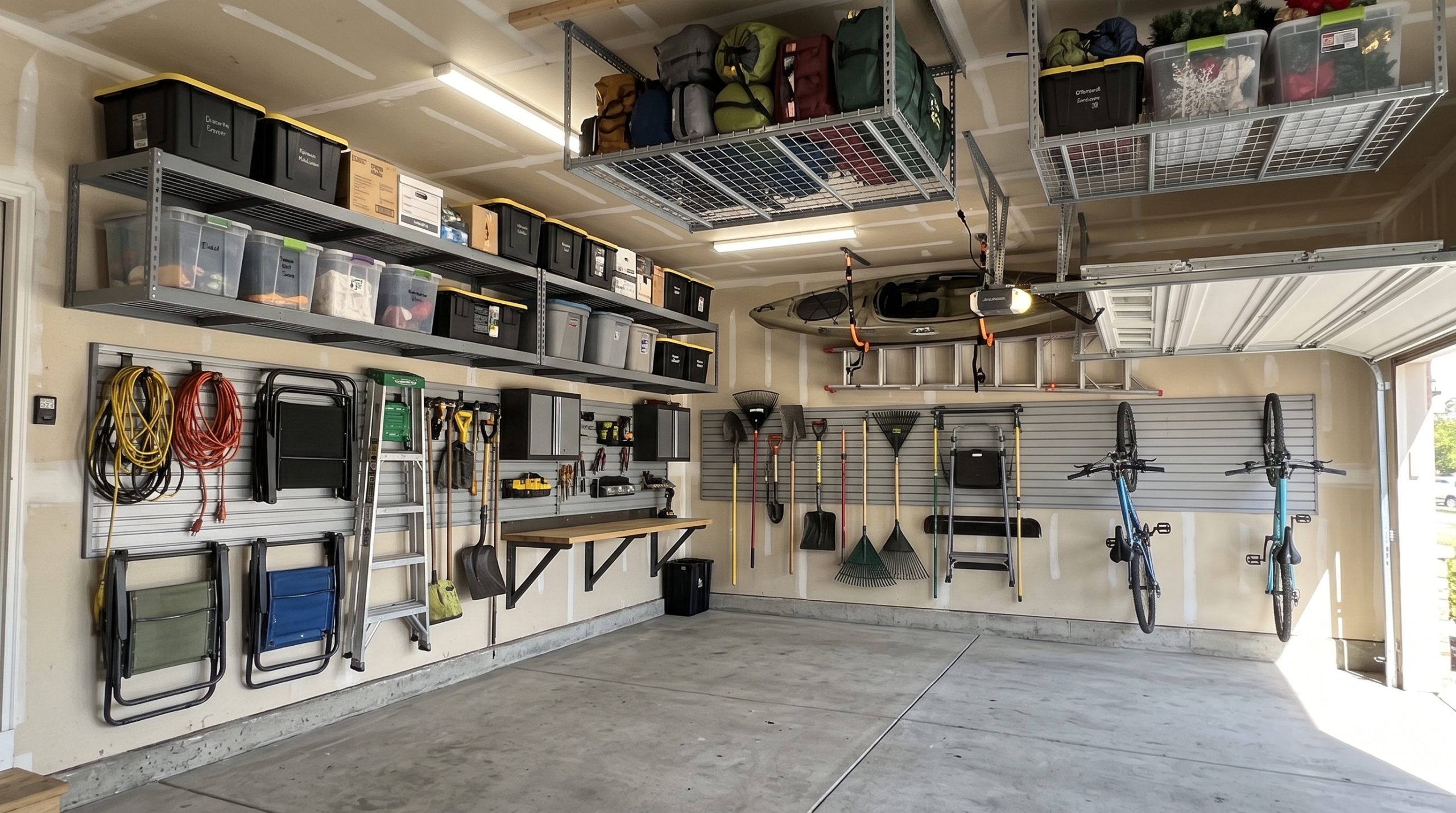




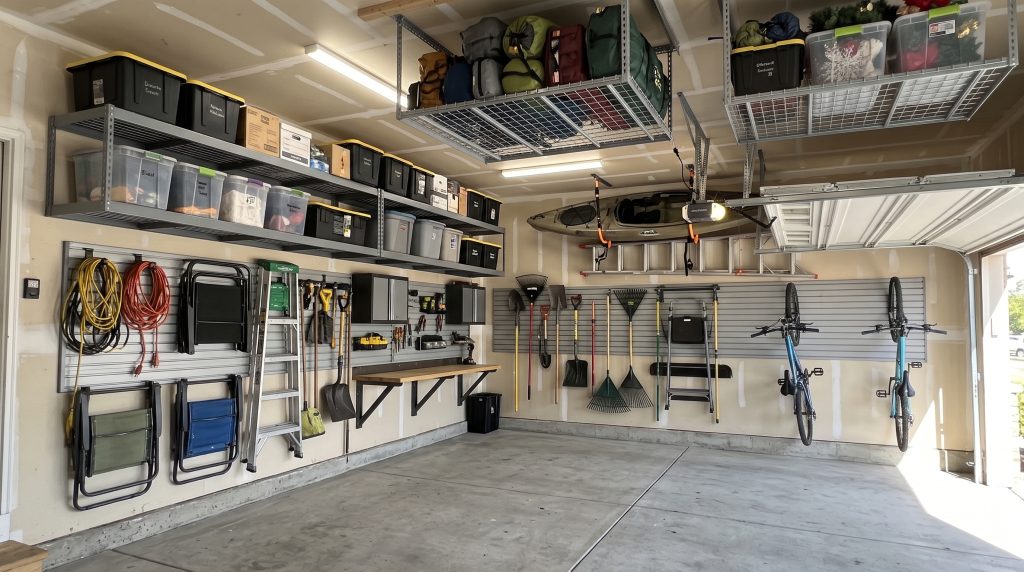
The easiest way to create more storage space in your garage is to think beyond the floor. By moving items onto the walls and ceiling, you take advantage of valuable space that often goes unused. In most two-car garages, the walls and the space above the garage door tracks provide some of the largest opportunities for additional storage. Wall-mounted shelving takes the bins, tools, and sports gear off the concrete. Cabinets absorb the loose small items. Overhead racks hold the things you touch twice a year. Done in that order, a standard garage gains real usable floor space back without a single item being thrown away.
Key takeaways
- Floor space disappears because storage is stored on the floor. Nearly every garage has 100 or more square feet of unused wall surface sitting above waist height.
- Wall systems return the most floor space per dollar. Start there, not with cabinets.
- Overhead racks are for low-frequency items only. Anything you reach for monthly should not be over your head.
- Weight ratings matter more than shelf size. Check the manufacturer’s published load rating and how the system anchors to your wall.
- Concrete, block, and truss-framed ceilings change the install. These are the situations where a professional install is worth it.
- Gasoline, propane, and pool chemicals do not belong in an enclosed cabinet next to a gas water heater.
Why Garage Floor Space Disappears So Quickly

Why your garage runs out of floor space even after you clean it out
Because the storage itself is taking up the floor. Plastic totes, free-standing shelf units, bike racks, and the “I will deal with this later” pile all occupy the same horizontal plane your car needs. Purging helps for a season, then the space refills, because nothing changed structurally.
The pattern is predictable. A garage gains storage volume over time (kids, hobbies, seasonal decor) but never gains square footage. So the overflow spreads sideways across the concrete until the second car stops fitting.
The fix: stop measuring your garage in square feet and start measuring it in cubic feet. A 20 by 20 garage with 9-foot walls holds roughly 3,600 cubic feet of volume, and most homeowners are only using the bottom three feet of it. Free-standing shelving does not solve this, because it converts floor space into storage rather than converting wall space into storage.
This gets more urgent the smaller the bay. If you are working with a single stall, start with Can You Fit Storage in a One-Car Garage? 8 Ideas That Actually Work, which covers the moves that fit when there is no room to spare.
Call a pro if: you have already decluttered twice and the garage still fills up. That is a layout and capacity problem, not a habit problem. Our guides on common garage layout mistakes and what makes a garage layout inefficient and cramped walk through the usual culprits.
Look Up: Why Vertical Garage Storage Matters
How to use vertical garage storage to free up floor space
Vertical storage matters because wall-surface is the only storage capacity in a garage that costs you nothing in floor space. Moving items from the floor to the wall is a straight one-for-one trade: every bin that goes up is a square foot of concrete that comes back.
Most garages have four zones people never touch:
|
Zone |
Typical unused area |
Best use |
|
Wall above waist height |
80 to 150 sq ft |
Shelving, sports organizers, hooks |
|
Above the garage door tracks |
15 to 30 sq ft |
Overhead racks |
|
Wall above windows and doors |
10 to 20 sq ft |
Shallow shelves |
|
Ceiling, front third of the bay |
40 to 60 sq ft |
Long-term overhead storage |
The fix: work top down. Long-term items go highest, seasonal items go mid-wall, daily items go at eye and hand level. This is the reverse of how most garages fill up, and it is why vertical storage is the fastest way to expand a garage.
Call a pro if: your garage walls are unfinished, block, or brick. Anchoring into those correctly takes different fasteners and different tools than a standard wood-framed wall.
What Belongs on Garage Shelving?
What to store on garage shelving (and what to keep off it)
Garage shelving is for items that are bulky, light to moderate in weight, and accessed a few times per year or less. That covers most of what is currently on your floor:
- Storage totes. The single biggest floor-space offender. Uniform bins on a shelf recover more square footage than any other move.
- Sports equipment. Bats, helmets, pads, and balls. These belong on a wall system rather than a bare shelf. A ball caddy or sports organizer keeps them contained instead of rolling off the edge.
- Tools. Hand tools and cordless kits, on shelving or in a cabinet. Keep them at working height.
- Camping equipment. Tents, sleeping bags, coolers. Light, bulky, and seasonal, which makes them ideal shelf candidates.
- Seasonal items. Holiday decor, lawn furniture cushions, snow gear.
Sports and camping gear are the two categories that defeat ordinary shelving most often, because the shapes are long, round, and awkward rather than boxy. A full wall system closes that gap: shelves carry the bins, tents, and coolers, and a ball caddy or sports organizer handles the balls, bats, and helmets. Where Do You Put Sports and Camping Gear in a Garage? 9 Ways to Get It Off the Floor covers those items specifically.
Keep off the shelves: anything you need weekly, anything liquid that can leak onto items below, and anything so heavy you cannot lift it safely down from height.
The fix: standardize your bins before the shelving is planned. Mixed tote sizes waste shelf depth. Uniform bins in one or two sizes let you use the full run. If you want to plan the run first, see how to choose the right garage shelving and the best garage shelving layout.
Call a pro if: you are stacking anything heavy above shoulder height. Load path and anchoring are the two things most often gotten wrong, and the failures show up months later, not on install day.
When Garage Cabinets Make More Sense
How to choose garage cabinets when you need floor space back
Cabinets make more sense when the problem is loose small items rather than bulk. Shelving is superior for volume. Cabinets are superior for containment, dust control, and hiding visual clutter.
Choose garage cabinets when:
- You have chemicals, fertilizers, or automotive fluids that should be behind a door and out of reach of children and pets.
- The garage is visible from the house or the street and you want a finished look.
- You need a work surface, not just storage.
One trade-off worth naming: base cabinets sit on the floor, so they consume floor space rather than returning it. If your goal is purely to get the car back in, wall-hung cabinets and shelving beat base cabinets. A mixed system usually wins, with wall storage carrying the volume and a short cabinet run handling the small stuff. Compare modular versus custom garage cabinets before committing.
Do not: store gasoline, propane cylinders, or pool chemicals inside a closed cabinet, especially in a garage with a gas water heater or furnace. Guidance from the National Fire Protection Association is to keep gasoline in approved, clearly labeled containers, in small quantities, away from any ignition source or pilot light. An enclosed cabinet traps vapor. If you are holding old fuel, solvents, or lawn chemicals you no longer use, dispose of them rather than storing them. Douglas and Sarpy County households have a free household hazardous waste drop-off in Omaha; Sarpy County publishes current hours and the accepted materials list.
Call a pro if: you want cabinets that stay square on a sloped garage floor. Most Omaha garage slabs pitch toward the door, and cabinet runs have to be shimmed and leveled to that pitch or the doors will not sit right.
What About Overhead Garage Storage?
How to add overhead garage storage without losing headroom
Overhead storage works when it is placed where headroom is not needed: above the garage door when it is open, along the front wall, or over the hood of a parked vehicle rather than over the middle of the bay.
The rule of thumb is simple. Measure from the floor to the lowest point of your open garage door, then to the roof of your tallest vehicle. The gap between those two numbers is your working overhead envelope. Racks hung below that envelope will eventually get hit. If parking is the whole point of the project, Can You Add Garage Storage and Still Park Two Cars? 7 Things to Measure First walks through every clearance check before anything gets mounted.
Overhead is the right home for:
- Holiday decorations
- Luggage and travel gear
- Off-season tires (weight permitting)
- Anything you access once or twice a year
Overhead is the wrong home for anything heavy, anything fragile, and anything you need in a hurry. For a fuller breakdown see what to store in overhead garage storage and is your garage safe for overhead garage storage.
Call a pro if: your ceiling is framed with engineered trusses rather than solid rafters. Trusses are designed for a specific load, and hanging several hundred pounds from the bottom chord without verifying capacity is a real structural risk. This is not something you can eyeball.
Why a Professionally Designed Garage Storage System Can Make a Difference
How a professionally designed garage storage system recovers more floor space
A designed system recovers more floor space than a piecemeal one because it plans the whole room at once instead of solving one wall at a time. Piecemeal storage tends to leave dead zones: the corner that nothing fits, the strip above the window, the run interrupted by an outlet.
What a professional design adds:
- Measured capacity. The plan starts from what you actually own, not from a product catalog.
- Full-run continuity. Shelving that runs the length of a wall stores far more than three separate units with gaps between them.
- Correct anchoring. Stud location, wall material, and load path get confirmed before anything is mounted.
- Zoning by frequency. Daily items at hand height, seasonal mid-wall, long-term overhead.
- Clearance planning. Car doors, mirrors, and the garage door path are accounted for on paper, before install.
A coordinated design also keeps the finishes consistent across cabinets, shelving, and walls, which matters more than people expect in a garage that opens toward the street. If you want to see a layout before committing, the sample garage renderings page shows what a planned garage looks like next to a piecemeal one.
Call a pro if: you are combining storage with new garage flooring. Sequence matters here. Coating a floor after cabinets are installed is far harder and more expensive than doing it first, and getting the order wrong is one of the more costly mistakes in a garage remodel.
Is Monkey Bars Garage Shelving Right for Your Garage?
How to tell if Monkey Bars garage shelving fits your garage
Monkey Bars shelving is the right fit when you need serious load capacity on the wall and you want the hanging layout to stay adjustable over time. The manufacturer and its dealer network publish a rating of 1,000 pounds per four-foot section for the shelving when properly installed, with the hook-and-bar components rated lower. Longer hooks carry less than short ones. Always confirm the rating for your exact configuration against the manufacturer’s documentation.
It is a strong fit if:
- You have a lot of sports gear. The system pairs shelving with a ball caddy or sports organizer, which is the configuration most households with kids in sports end up needing.
- You have long or awkward items that never sit well on a flat shelf. Bike hooks take the bicycles, tool hooks take rakes, shovels, and brooms, and hangers take folding chairs, cords, and other smaller items.
- Your storage needs change year to year and you want to move hooks without redoing the wall.
- You have 9-foot or taller ceilings, which open up the deeper shelf options.
It is a weaker fit if your ceilings are low, your storage is almost entirely small loose items (cabinets serve that better), or your walls cannot be anchored properly.
For the full detail, see what Monkey Bars garage storage is and how it works, how Monkey Bars garage storage safety is tested, and when homeowners should invest in Monkey Bars storage.
Call a pro if: you want the published load rating to actually apply. These ratings assume correct fastener type and correct engagement with structure. A system rated for 1,000 pounds anchored into drywall alone is not rated for anything.
What needs a professional install
|
Task |
Who handles it |
Why |
|
Sorting, purging, standardizing bins |
Prep step |
No structural risk, and doing it before the measure makes the design accurate. |
|
Shelving mounted into wood studs |
Professional install |
Stud centers have to be confirmed across the full run. Drywall anchors will not carry a loaded shelf. |
|
Wall-hung hook and bar systems |
Professional install |
Long runs have to stay level and engage structure at every mounting point. |
|
Anchoring into concrete, block, or brick |
Professional install |
Requires the correct fastener and a hammer drill. Wrong anchor equals eventual failure. |
|
Full-wall shelving runs at height |
Professional install |
Leveling across a long run and confirming load path at every mounting point. |
|
Overhead racks on engineered trusses |
Professional install |
Truss load capacity must be verified. Structural risk if it is not. |
|
Base cabinet runs on a sloped slab |
Professional install |
Requires shimming and leveling to the floor pitch. |
|
Storing fuel, propane, or pool chemicals |
Neither |
These should not be in an enclosed garage cabinet at all. Dispose of them instead. |
The bottom line

Every garage has more storage capacity than it is using, and almost all of it is above waist height. Get the bins off the concrete and onto the walls, put the twice-a-year items overhead, and reserve cabinets for the loose small stuff that needs a door. Do that in order and the floor space comes back without anything being thrown away. Staying ahead of it afterward is mostly a matter of habit, and our guide to keeping a garage clutter free year round covers that side of it.
If you would rather have the whole room planned at once instead of solving it one wall at a time, Platinum Garage Solutions designs and installs complete garage storage systems across Omaha and the surrounding communities.
Schedule your garage storage consultation and get a design of your space before anything is installed.