



Is your garage filled with clutter? Is it tough to find what you need, or has parking become a challenge? For years, homeowners have relied on traditional storage options, such as garage shelves and pegboards. These can support basic garage organization, but they often fall short when storage needs grow or change.
While these storage solutions may seem convenient at first, they come with drawbacks that limit how much of your garage space you can truly use. Understanding these limitations is an essential step toward selecting a garage storage system that delivers better function, cleaner layout, and long-term flexibility for your home.
Understanding Traditional Garage Storage: Shelves and Pegboards
When homeowners think about garage organization, two familiar options usually come to mind: garage shelving and pegboards. Both have been common choices for reducing mess and creating some structure in the garage. They offer straightforward storage and are easy to find in many home improvement stores.
Garage shelving and pegboards handle basic storage needs, but their designs have stayed essentially unchanged for decades. They work in simple situations, yet they aren’t built for the variety of modern gear or the shifting storage demands many homeowners face today. By reviewing how these systems function and where they fall short, it becomes easier to decide whether a more flexible garage storage solution is the better fit.
These older storage styles became popular because they were easy to install and suited light, predictable storage needs. A few bins on shelves and a row of hand tools on hooks felt like it was years ago. Garages today are asked to do more, so storage has to handle heavier loads, larger items, and frequent rearranging. That shift exposes the gaps in traditional systems.
Homeowners who want to understand why modern wall systems outperform older setups should also read What Makes Garage Slatwall Better Than Shelves or Pegboards?
Common Uses for Garage Shelving and Pegboards
Garage shelving and pegboards help homeowners lift items off the floor and add basic structure to garage storage. These options are widely used for simple organization needs, especially when the goal is to clear walking areas and keep everyday items within reach.
Homeowners often store items such as:
- bins for seasonal supplies or holiday décor
- small power tools and hand tools
- garden equipment and cleaning supplies
- sports gear that needs fast access
These items typically work on shelves or pegboards because they’re light, uniform, and easy to stack or hang. The challenge arises when garages need storage for bulky equipment, long-handled tools, or gear that changes with the seasons. Traditional layouts don’t adapt quickly, and that leads to overflow on the floor or into corners.
Garage shelving and pegboards handle straightforward storage, yet they lack the flexibility and customization of a garage slatwall system. A garage slatwall uses panels with horizontal grooves that accept hooks, shelves, baskets, and bins. This creates a vertical garage storage layout that can be adjusted to match changing needs, while keeping the space cleaner and more open.
If you’re curious why homeowners are moving beyond these basic setups, read Why Are Homeowners Choosing Slatwall for a Cleaner, More Modern Garage to know how modern wall systems improve both storage and the overall look of the space
Key Features of Shelves and Pegboards in Garage Organization
The features of shelves and pegboards determine their capabilities within your garage. Shelves are typically static structures, while pegboards offer a bit more flexibility with hook placement on the wall space.
However, both storage options have distinct characteristics that influence their effectiveness. The table below outlines some key features of each storage system.
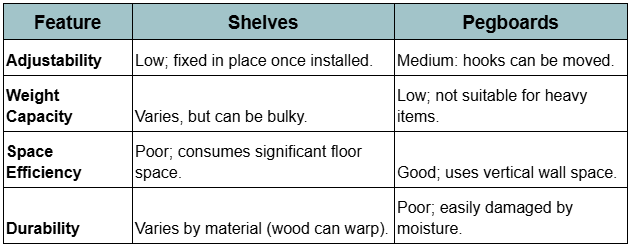
The chart shows a clear pattern: shelving depends heavily on floor space and stays in a single layout, while pegboards offer some flexibility but lack strength. Both systems can help with light storage, yet neither is designed for growing gear collections or changing garage routines.
When compared to modern systems, especially for tool storage, garage slatwall panels offer superior strength and durability, as well as a much wider range of accessory options than a standard pegboard.
Limitations of Shelves for Garage Storage
Although garage shelving can seem like an easy way to add storage, it often creates challenges in an active garage. Most shelving units are large and rigid, taking up more room than they save. Instead of opening the space, they can crowd it, making it harder to park, move around, or set up work areas.
Shelves also rely heavily on floor space, which limits how much storage you can add without making the garage feel tight. Items end up stacked or pushed to the back, slowing down and making it inefficient. This setup may work for uniform bins, but it struggles with bulky or oddly shaped gear that needs flexible placement.
Another concern is that shelving often locks you into a single layout. Once installed, adjusting shelf height or position is not always simple, especially with heavier storage loads. If your garage storage needs shift over time, shelves can become a limiting option rather than a long-term solution for garage organization.
Even DIY shelving guides note that tall or bulky shelves quickly become hard to access, pushing items out of reach and reducing day-to-day usefulness.
Another drawback is workflow. When shelves fill up, items end up stacked high or pushed deep, making them harder to access. You may need to move several bins just to reach one tool. Over time, that slows projects and encourages clutter to return. A system that organizes by wall zones instead of floor piles supports faster access and better long-term organization.
For a full breakdown of how slatwall solves these space-and-access issues, read How Does Slatwall Improve Garage Storage Capacity and Flexibility.
Space Constraints with Garage Shelving
A major drawback of freestanding garage shelving is the amount of floor space it consumes. Every square foot in a garage matters, especially when you need room for parking or a workshop area. Large shelving units can block vehicle space, narrow walkways, and limit how you use the garage day to day.
Freestanding shelves also create unused wall areas. Because their dimensions are fixed, they rarely match your exact storage needs. That can leave awkward gaps around seasonal bins, bulky gear, or tall items, reducing overall storage efficiency.
Corners and narrow wall sections are also hard to use with freestanding shelving. If a unit is even a few inches too wide, that space becomes wasted. The result is storage that feels full even when parts of the garage remain unused. Vertical wall systems solve this by covering tight areas and turning awkward wall zones into usable storage.
Moisture is another concern. Many wood shelving units can warp or weaken in humid conditions. By contrast, wall-based systems such as PVC slatwall handle humidity far better. PVC resists moisture, maintains its shape, and lasts longer in demanding garage environments.
Challenges with Adjustability and Customization
Garage storage needs shift over time as seasons rotate, hobbies change, or families grow—traditional shelving struggles to keep pace because adjustability is limited. After installation, most shelf layouts remain locked in place, making this one of the least flexible garage storage options.
When storage demands change, shelves can quickly become frustrating. You may need different heights for taller items or more clearance for oddly shaped equipment, but standard shelving rarely adapts without major effort. That limitation often pushes homeowners toward custom storage solutions such as slatwall panels, which combine strength with fast layout changes.
A garage rarely stays the same year after year. New hobbies bring new gear, older equipment gets replaced, and seasonal items rotate in and out. When storage can’t keep up with those changes, the organization breaks down. Adjustable wall storage lets you reconfigure zones in minutes, keeping the garage functional without having to rebuild the setup.
Common shelving limitations include:
- Shelf heights are fixed, making it difficult to store taller gear.
- Shelf depth remains the same, reducing efficiency for both small items and oversized equipment.
- Repositioning shelves usually requires complete disassembly and reinstallation, making upgrades time-consuming.
Limitations of Pegboards for Garage Organization
Pegboards are still common in many garages and workshops because they let homeowners hang tools on the wall. While they clear a few items off the floor, pegboards aren’t strong or versatile enough for reliable garage organization. Their design works for light-duty storage, but it often struggles in an active garage where gear changes and storage demands grow.
The panels are thin, and the hole-based layout weakens over time, especially when holding heavier equipment or when hooks get moved often. As holes widen, hooks can slip, and items may shift out of place, reducing stability and usable wall storage.
Humidity adds another challenge. Pegboards can sag or soften in damp conditions, leading to faster wear and less dependable storage. For homeowners who need durable, adjustable wall systems that support a wider range of equipment, stronger modern options deliver better long-term performance than pegboard.
Pegboards also limit layout options. Hooks must align with existing holes, so spacing isn’t always ideal for larger tools. Over time, hooks can tilt or loosen, and tools may not stay level. That creates uneven storage zones and reduces usable wall space, especially for heavier items.
Weight Capacity and Durability Issues
A major downside of pegboards is their limited strength and low weight-bearing capacity. Most pegboards are made from pressed wood or particleboard, which is not designed for heavy garage storage. When you hang items beyond light tools, the board can tear, or the hooks may pull free, making the setup unreliable for larger equipment.
Pegboards also break down quickly in typical garage conditions. Moisture and humidity can cause the board to warp, swell, or crack over time. That weakens the panel on the wall and reduces confidence that it will hold items securely for long-term garage organization.
Hands-on tests show the standard pegboard is best kept to light-duty use because performance drops quickly outside ideal setups.
When a wall system can’t reliably support weight, it creates safety concerns and pushes gear back onto the floor. A stronger wall solution keeps heavy items securely at an easy-to-reach height, preventing shifting or slipping.
A professional garage slatwall system performs far better under the same demands. Slatwall panels are engineered for higher load capacity and durability, allowing homeowners to store heavier gear safely without worrying about accessories pulling out or items dropping onto the garage floor.
Limited Versatility Compared to Garage Slatwall Organizer
Pegboards offer limited versatility for garage storage. They are designed mainly for small hooks, so they work best for hanging individual hand tools. Beyond that, there aren’t many practical ways to expand their use. Most garages need storage for a wider mix of items, and pegboards rarely meet those changing demands.
A garage slatwall organizer is explicitly built for better garage storage and organization. Slatwall panels support a wide range of accessories, so homeowners can customize wall storage to meet their exact needs. With slatwall, you’re not locked into a single narrow setup—you can adjust layouts anytime and keep your garage organized as your routines shift.
Slatwall’s modular design is the core difference. Instead of being limited to small hooks, you can select accessories that match different item sizes, weights, and storage zones. This creates a garage storage layout that supports daily routines and seasonal changes without crowding the floor or requiring a complete reinstallation.
Unlike pegboards, slatwall systems can support deep shelves for bins and paint cans, heavy-duty brackets for bicycles and ladders, large wire baskets for sports equipment, and specialized holders for hoses and power tools. This makes slatwall far more flexible for modern garage storage, keeping gear secure, visible, and easy to access.
Traditional garage storage, such as shelving and pegboards, can help with basic organization, but it doesn’t deliver the same value as modern garage slatwall systems. Slatwall expands vertical garage storage, clears floor space, and makes it simple to adjust accessories as your needs change. It also supports a cleaner, tidier garage appearance, which many homeowners want for a functional, modern space.
Platinum Garage Solutions provides high-quality garage slatwall systems designed around your storage goals and garage layout. Our technicians handle every step of the installation process, ensuring a durable result that adapts over time. Contact us today or give us a call to schedule a consultation and explore how a custom slatwall setup can transform your garage into a more organized, usable space.
Frequently Asked Questions
Garage slatwall systems support heavier tools than pegboards and free up floor space, unlike bulky shelves. Accessories slide into grooves for secure, customizable wall storage, keeping tools visible, organized, and easy to access.
Popular slatwall accessories include heavy-duty hooks for bicycles and ladders, deep shelves for bins, wire baskets for sports gear, and specialty holders for hoses or power tools. Select accessories based on what you store most often.
Start by listing what needs wall storage, then measure available wall space. Choose PVC slatwall panels for durability and moisture resistance. Map zones for tools, sports gear, and yard equipment, then select matching hooks, racks, and shelves.
Slatwall panels expand vertical garage storage, clear the floor, and enable quick layout changes. They hold heavy gear securely, improve access to tools, and support a clean, modern garage appearance.
Focus on material, load capacity, and accessory range. High-quality PVC slatwall resists humidity and supports heavy items. Also consider panel size, finish, and how easily accessories can be rearranged.
DIY installation is possible, but professional installation ensures panels are level, secured to studs, and cut precisely around outlets or fixtures. That delivers stronger load support and a smoother, more polished result.
Add cord wraps, tool racks, deep baskets, and heavy-duty shelves to handle mixed storage needs. Specialty brackets work well for bicycles, ladders, and yard tools, keeping everything in a defined spot.
Yes. PVC slatwall needs minimal upkeep. Wipe panels with a damp cloth for dust, and use a mild cleaner for stubborn marks. The smooth, non-porous surface resists stains.
Capacity depends on the panel and accessories. High-quality PVC slatwall can support substantial loads when installed correctly, making it suitable for bicycles, ladders, power tools, and full bins.
The main issue is inadequate fastening. Panels must be secured to wall studs to safely handle heavy loads. Proper spacing and aligned grooves also matter for smooth accessory mounting and long-term durability.


